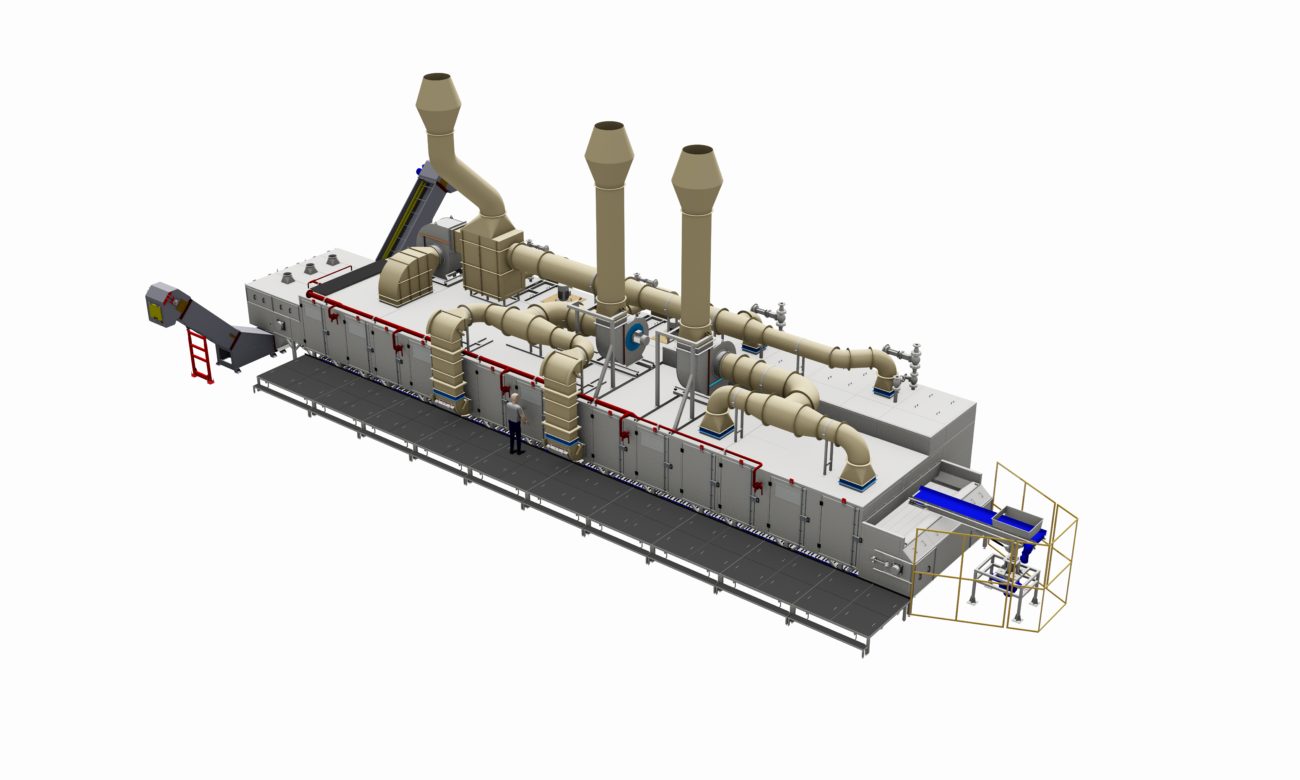
Belt dryers manufactured by MYSAK Group are devices for continuous drying of raw materials in the food, chemical and related industries – individually designed and manufactured taking into account the properties of the raw material, the line capacity and the available heat source. A belt dryer removes moisture by convection: precisely controlled warm air is evenly distributed over the layer of product as it moves along the belt through successive drying modules. Depending on the size and complexity, we manufacture belt dryers in our own production facility (workshop) in Mrowino near Poznań. We remain in close contact with the customer throughout the entire process, from design to commissioning.
A belt dryer is a device for continuous drying of bulk and piece-form materials, in which the product moves on a belt (mesh) through successive heated air zones, losing moisture while preserving the shape and structure of the particles. This is the key advantage of this technology compared to fluidised-bed or pneumatic dryers – the product is not intensively mixed or suspended, which protects delicate raw materials from mechanical damage.
Belt dryers are used, among other applications, for drying:
It is worth noting that belt dryers are particularly well suited for the production of herbs and spices – where preserving the aroma and colour of the product requires gentle, low-temperature drying with precise control of airflow. More on applications in the food industry: Food industry – machines and installations.
The dryer consists of drying modules, a starting module and a finishing module. The raw material inlet is located at the top of the starting module and is fed by a belt conveyor. The dried product outlet is located at the bottom of the final module. The drying modules are equipped with an air heater and a circulation fan.
To intensify the drying process, the air flows in the opposite direction to the movement of the product – in one module from bottom to top, and in the next from top to bottom. The dried product is conveyed by moving stainless steel sheets attached to chains on both sides. The chain rollers run along guides.
The belt dryer also consists of an air intake with a filter, air heaters, fans, a pressure washing system for the mesh belt, and a condensate supply and discharge system (in the case of steam heaters).
The main components of the belt dryer are:
The technological solutions used allow the conveying sheets to be washed, which is essential for maintaining the high level of hygiene in food processing installations. The materials used can be approved for food contact and comply with GMP and HACCP requirements.
The process parameters of each belt dryer are individually selected according to the specific raw material and production line. The final technical specification is determined by:
Contact our technical department for indicative parameter ranges for your raw material.
The price of a belt dryer depends on many factors that determine the final project cost:
We want our belt dryers to meet every customer’s needs, therefore before starting work, our experts collect all the necessary data to construct a device tailored to the relevant industry, site conditions and production line. Browse the product catalogue and see our completed projects.
MYSAK Group has been designing and manufacturing belt dryers for over 20 years – for the food, chemical and related industries, in Poland and abroad. Depending on the size and complexity, we manufacture in our own production facility (workshop) in Mrowino near Poznań, which allows us to maintain full control over manufacturing quality and delivery schedules.
Each belt dryer is individually designed – from concept design, through 3D documentation and P&ID drawings, to installation, commissioning and staff training. All our equipment complies with national and European standards, including the machinery directives and ATEX requirements where the characteristics of the raw material require protection of potentially explosive atmospheres.
Find out more and contact our experts. MYSAK is your guarantee of high-quality equipment that will help your business grow.
A belt dryer is a device for continuous drying of materials, in which the product moves on a belt through successive heated air zones. This enables uniform and repeatable moisture removal while preserving the shape and structure of the dried raw material.
It consists of drying modules, a belt transport system (stainless steel sheets or mesh), air heaters, circulation fans, and filtration, transport sheet washing and control systems. The modules can operate with different airflow directions, which intensifies heat transfer at minimal energy consumption.
Belt dryers are used for drying fruits, vegetables, mushrooms, herbs and spice plants, biomass and briquettes, animal feeds, breakfast cereals, snacks and granola. A key factor when selecting a belt dryer is the delicate structure of the raw material – a belt dryer does not cause mechanical damage to dried material.
A belt dryer provides continuous operation, uniform drying, precise temperature control in each zone and easy integration with the production line. The multi-level belt configuration enables high capacity while reducing the required installation footprint.
A belt dryer is a modular system with multiple independent drying zones, where the airflow direction changes between modules (from bottom to top / from top to bottom). A tunnel dryer is typically a single long chamber with uniform airflow. The modular design of a belt dryer provides greater flexibility when changing raw materials and easier maintenance access.
Yes. Each system is individually designed to meet the required capacity, available space, product parameters and hygiene standards applicable to the specific facility.